Walker AI Systems

Recorded runs and live demos, one standard

Proof that publishes its own misses

Six things you can inspect. Two are recorded runs of real agent fleets: real model calls, real tool calls, real costs, scored against a written answer key the fleet cannot see, with the misses published next to the successes. Two run live in your browser on documents you bring. Two are operating systems, labeled for exactly what is real and what is sample data. Every card answers the same four questions: what process this is, what failure it is built to catch, what the measured run did, and what you can open right now.

01  /  Recorded systems

Recorded systems

Full runs of an agent fleet across four systems, recorded once and replayed. The numbers are counted from the recording, not estimated, and the runs before the latest one, including the worse ones, are on each page.

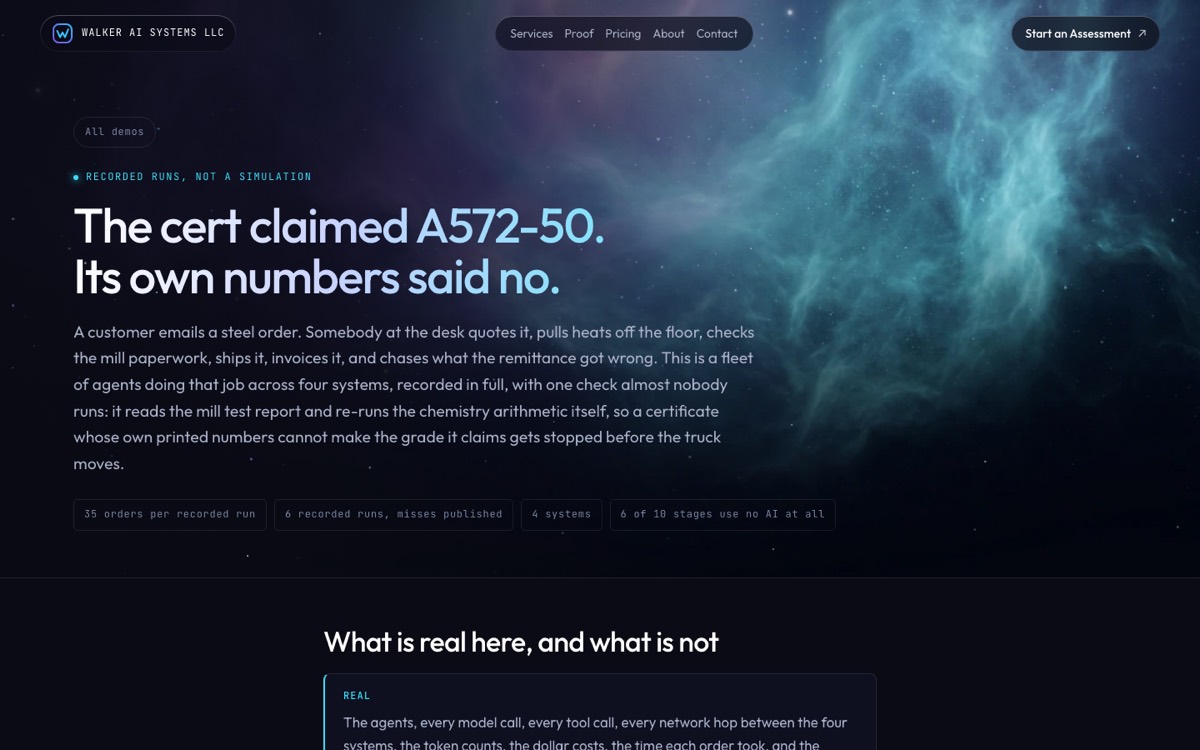
The steel demo page: the recorded order queue and the certificate gate

Steel service center: quote to cash, with a chemistry gate

The process
A steel order desk end to end: intake, quoting, allocation off the floor, shipping, invoicing and reconciliation, across four systems.
What it catches
A mill test report whose own printed chemistry cannot make the grade it claims. A deterministic gate re-runs the arithmetic against the published ASTM window and blocks the certificate with the element named.
The measured run
Latest run 2026-08-05: 35 orders, 19 shipped, 12 escalated to a person, 4 certificates blocked, 1 short pay caught, 0 failed. $1.75 for the run, about five cents an order. Six recorded runs in all, misses published.
Open it
Three of the 35 orders replay on the page, chosen to end on a blocked certificate rather than on three successes.
  • 35 orders per run
  • 6 recorded runs
  • 4 certs blocked
  • $0.05 an order
Watch the recorded run

Checking certs by hand today? The guide to reading a mill test report covers the anatomy, the tells and the limits this gate enforces.
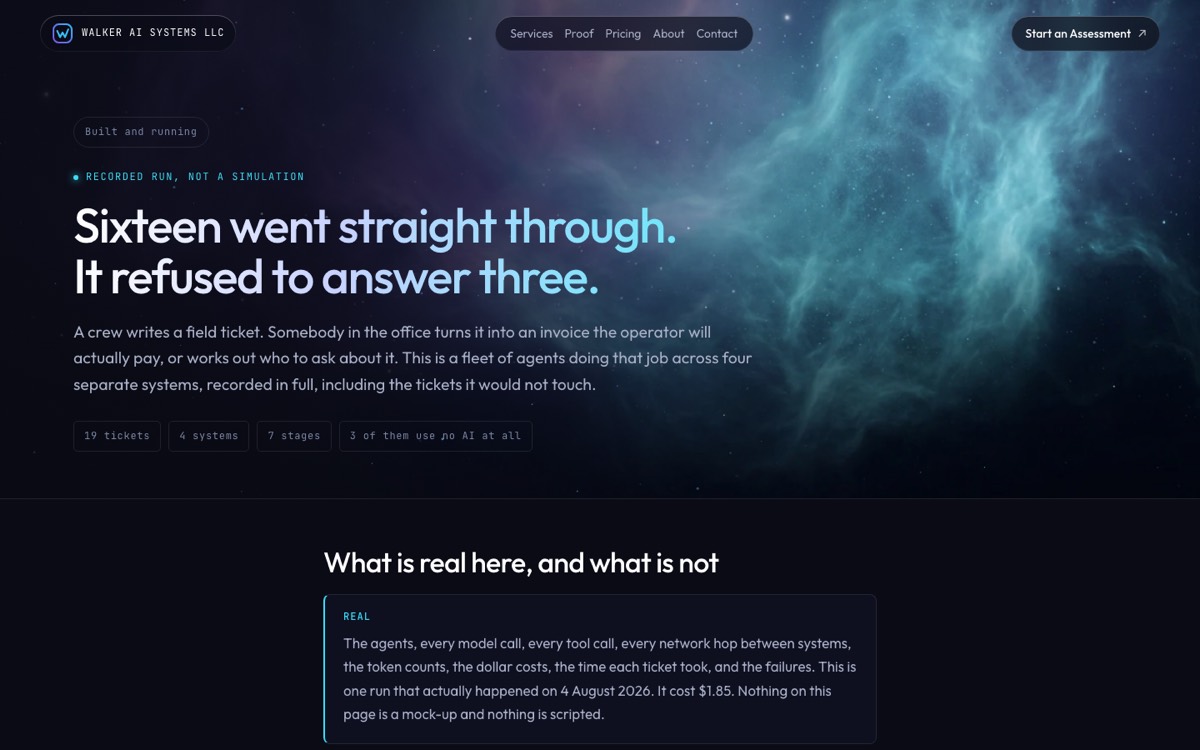
The oilfield demo page: the ticket queue and one ticket moving through the stages

Oilfield services: field ticket to cash

The process
A field ticket becomes a priced, coded, compliant invoice across four systems: ERP, ticketing, billing and the operator's payment portal.
What it catches
A ticket with no valid automated answer. The fleet refuses it and escalates it to a person with a specific question attached, and a short pay is caught after the remittance arrives.
The measured run
Latest run 2026-08-04: 19 tickets, 16 straight through, 3 escalated on purpose, 1 duplicate closed, 1 short pay caught, 0 failed. $1.85 for the run, about ten cents a ticket, 11 minutes of wall clock. Nineteen tickets is an order of magnitude, not a rate.
Open it
Three of the 19 tickets replay on the page, including the one the fleet refused to answer.
  • 19 tickets
  • 16 straight through
  • 3 refusals, on purpose
  • $0.10 a ticket
Watch the recorded run

Still retyping tickets into a portal? The guide to field ticket billing walks the seven places the money leaks and why portals reject.

02  /  Try it yourself

Try it yourself

These run in your browser, on the sample documents provided or on one you upload. The AI read is metered, five a day per visitor and fifty across the site, and the page says so when the quota is spent. Nothing here is recorded, so the outcome is whatever your document produces.

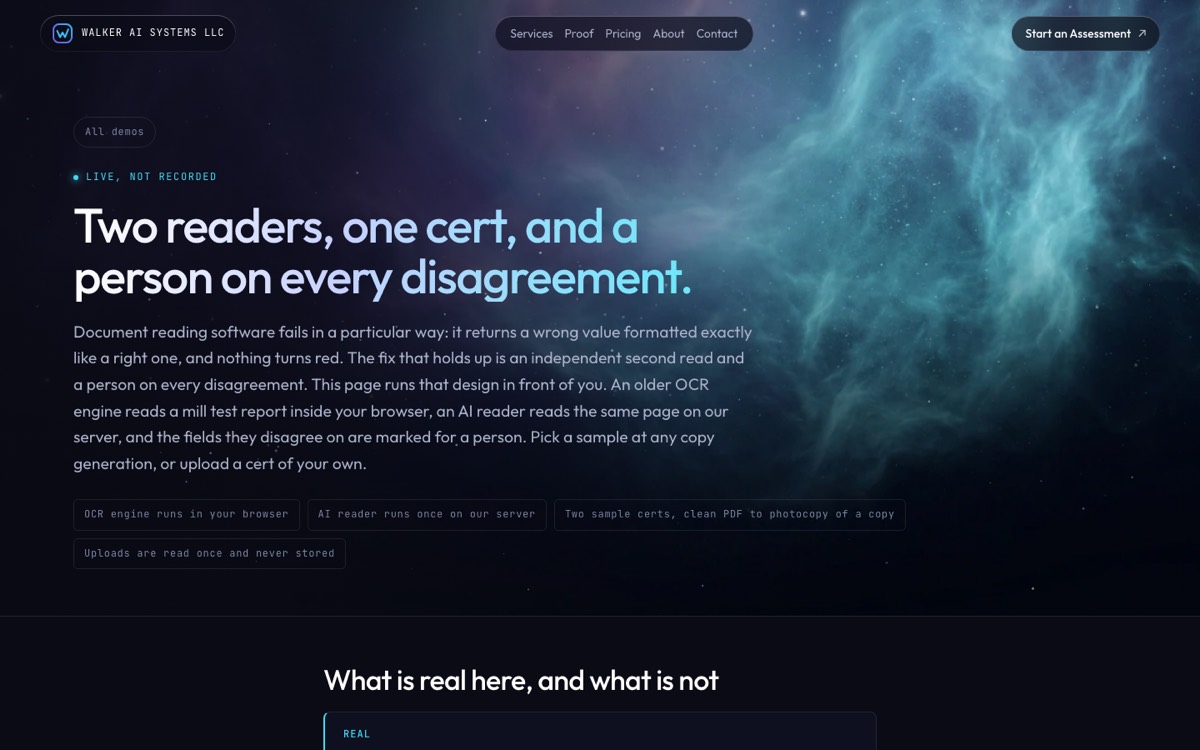
The two readers demo page: a sample certificate and the two readers side by side

Two readers, one certificate, a person on every disagreement

The process
Reading a mill test report into your records: heat number, yield, tensile, elongation.
What it catches
A wrong value formatted exactly like a right one. An older OCR engine and an AI reader read the same certificate independently, and every disagreement goes to a person with the page beside them.
The measured run
Live, not recorded. The sample certificates ship with an answer key, so the page scores each read as right, wrong, or caught before it entered the records. The outcome is whatever your document produces.
Open it
Pick a sample, from a clean PDF to a low-toner copy, or upload a scan or photo of your own certificate.
  • Runs in your browser
  • Two independent readers
  • 5 AI reads a day
  • Answer key on the samples
Run it on a certificate
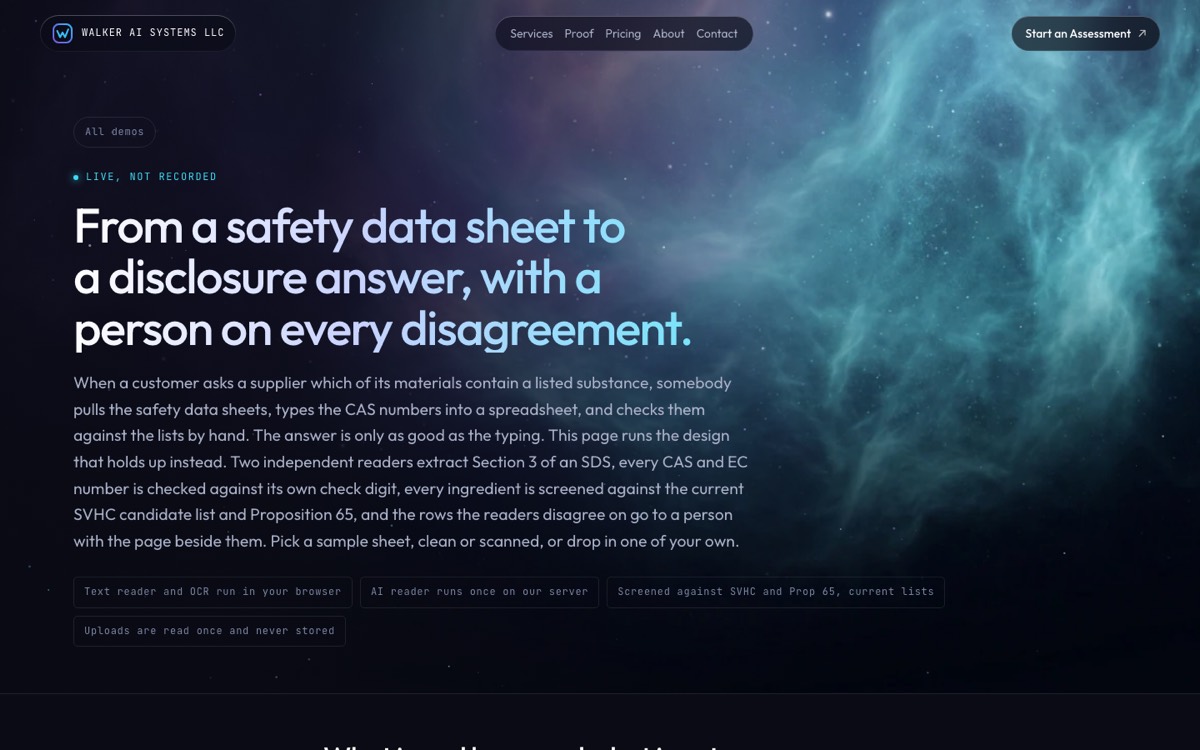
The disclosure demo page: a sample safety data sheet and the screened ingredient table

From a safety data sheet to a disclosure answer

The process
Answering a customer's substance-disclosure request from safety data sheets: which materials contain a listed substance, and in what range.
What it catches
A CAS number typed wrong by hand. Two readers extract Section 3, the check digits are verified, and every ingredient is screened against the REACH candidate list and California Proposition 65.
The measured run
Live, not recorded. Five synthetic data sheets ship with an answer key. A worklist shows what a person still has to look at, and a CSV of the screened rows downloads at the end.
Open it
Pick a sample sheet as a PDF or as a scan, or upload your own.
  • Runs in your browser
  • SVHC and Prop 65 lists
  • 5 AI reads a day
  • Worklist and CSV
Screen a data sheet

03  /  Live operational proof

Live operational proof

Two systems that run rather than replay. Both are labeled on the page for what is real and what is sample data.

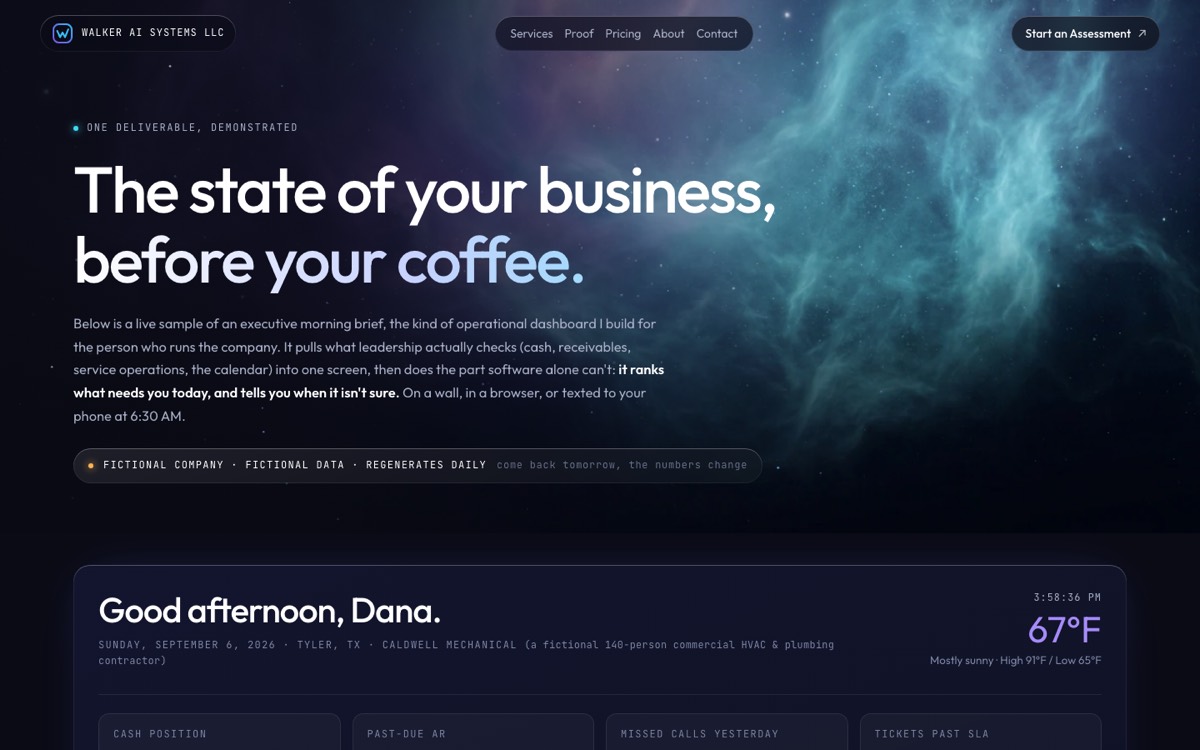
The executive morning brief demo: one screen of ranked items for the person who runs the company

The executive morning brief

The process
The morning brief for the person who runs the company: cash, receivables, service operations and the calendar on one screen at 6:30 AM.
What it catches
A dashboard that reports everything and ranks nothing. This one ranks what needs you today and says when it is not sure.
The measured run
The company is fictional and the data regenerates every day, and the page says both. What a real engagement changes is the wiring behind it.
Open it
Today's sample brief, live.
  • Regenerates daily
  • Fictional company, labeled
  • Ranks, and flags uncertainty
See today's brief
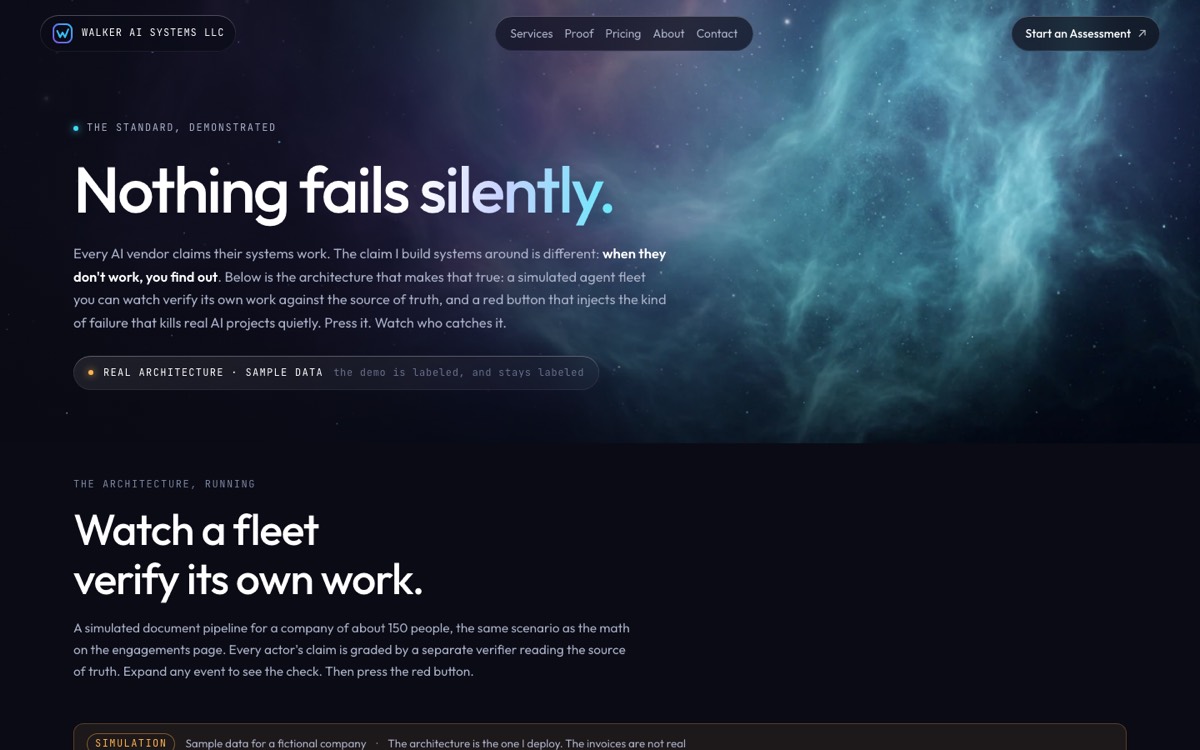
The reliability page: the simulated fleet, the red button, and the live purge job log

The red button

The process
Operating an AI system after it ships: verification against the source of truth, and the monthly report the client receives.
What it catches
The silent failure. Press the red button to inject a wrong value and watch the verification pass catch it and route it to a person.
The measured run
The fleet is a labeled simulation on sample data. Below it, this practice's own retention purge job is read live from the database that records every execution, and that part is not a simulation.
Open it
The button, and the live job log under it.
  • Simulation, labeled
  • Real purge job, read live
  • Monthly report standard
Press the red button

The rest of the record

  • The receipts: 26 verified AI failures in production, one record each, with the primary source and who caught it.
  • The verification log: every claim on this site checked at the source, with the date it was checked.
  • The incident platform case study: the platform, and a replay of one recorded incident end to end.
  • The guides: what AI consulting costs, how to read a mill test report, where field ticket billing leaks.

The standing rule for everything on this page: a recorded demo goes public only once a run with a published miss rate exists, a live demo says it is live, and anything on sample data says so on the page. No mockups presented as live systems, no highlight reels, no accuracy claims without a denominator and a key.

Does one of these resemble your paperwork?

Tell me which example fits, how often the work arrives, and where the result needs to go. The $2,500 assessment tests whether a build makes financial sense for your operation. The written report is yours whether or not we build anything.

Discuss your document workflow

One workflow in a smaller business? See the $1,500 automation sprint.

$2,500, fixed scope Start an Assessment